

Tile adhesive consumption per square meter — why does it matter? Accordingly, here's what you need to know
When tiling, one of the most important questions that arises is how much tile adhesive is needed per square meter. Knowing the answer to this question helps you estimate the required materials more accurately and prevents both unnecessary expenses and adhesive shortages during installation.
However, tile adhesive consumption is not a fixed number; in fact, it depends on factors such as the type of adhesive, tile size, substrate condition, and application thickness. Therefore, calculating adhesive consumption correctly before starting work is essential.
In this article, we will examine how much tile adhesive is typically needed per square meter, what factors influence it, and how to calculate the required amount properly so that the project is carried out with minimal waste and the best possible results.
What is the average tile adhesive consumption per square meter?
What factors increase or decrease tile adhesive consumption per square meter?
How does adhesive consumption differ between floors and walls?
How many square meters can be tiled with one bag of tile adhesive?
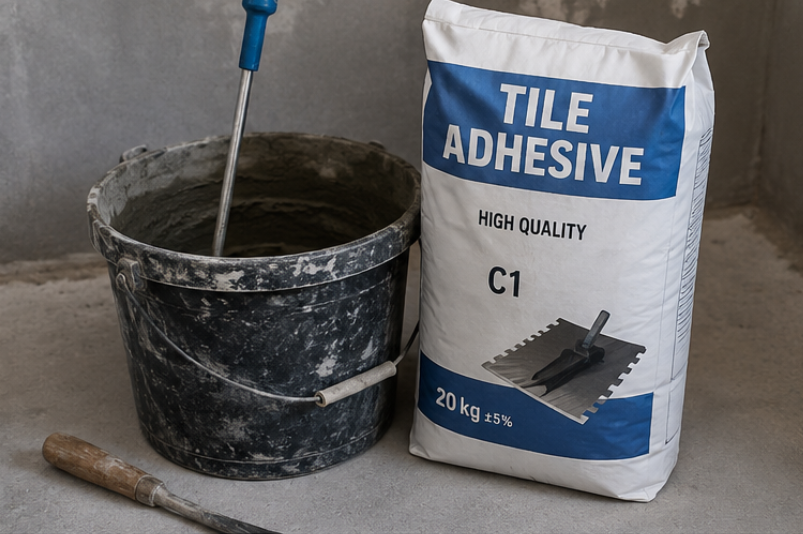
Average tile adhesive usage per square meter — accordingly, what you can expect
If we want to provide an approximate figure for tile adhesive consumption, typically the consumption of powder tile adhesive ranges between 3 to 6 kilograms per square meter. However, this is a general average and can vary depending on specific conditions.
For example, smooth and level substrates with standard medium-sized tiles usually need 3 to 4 kg/m². On the other hand, uneven surfaces or large, heavy tiles can increase this amount to 5 or even 6 kg/m².
For paste tile adhesive, the required amount is usually between 2 to 4 kg/m². However, this type is more common for walls and interior spaces. Powder adhesives are generally preferred for most flooring projects.
Many people overlook an important point. The figures printed on adhesive packaging are usually calculated under ideal conditions. In practice, factors like tile water absorption, installer skill, trowel notch size, and substrate condition affect the actual amount needed. Therefore, always allow a margin of safety when estimating materials.
For example, a 50 m² area with an average of 4 kg/m² needs about 200 kg of adhesive. However, uneven substrates or large tiles could raise this to 250–300 kg.
For this reason, a fixed number cannot apply to all projects. In fact, understanding the key influencing factors matters more than knowing a single average number. Accordingly, the next section will examine the most important factors affecting adhesive consumption.
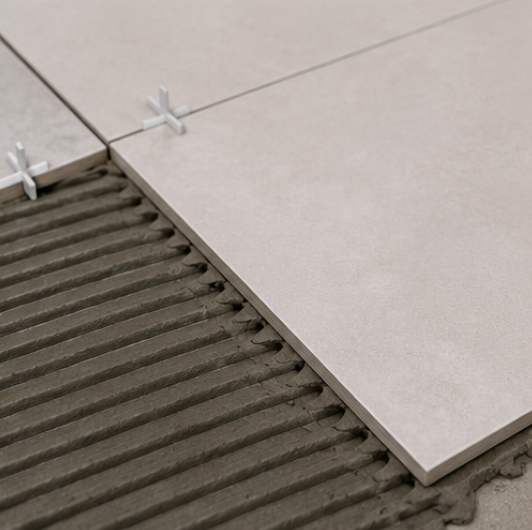
Factors affecting tile adhesive usage per square meter — accordingly, what you need to know
Many people assume that the amount of adhesive needed depends only on the area to be tiled. However, in reality, various factors can significantly change this amount. As a result, two projects with the same square footage may require completely different quantities of adhesive. Therefore, if you understand these factors in advance, you can estimate costs more accurately and avoid purchasing too much or too little adhesive.
Substrate flatness or unevenness
One of the most important factors affecting adhesive consumption is the condition of the surface on which the tiles will be installed. When the substrate is perfectly smooth, level, and properly prepared, the adhesive spreads evenly and the required amount stays within the standard range.
However, if the surface has depressions, bumps, or unevenness, the installer must use more adhesive to compensate for these height differences. In such cases, the amount of adhesive needed increases considerably. Therefore, proper substrate preparation before tiling can play a major role in reducing project costs.
Tile size and weight
The larger the tile, the more adhesive is generally required. Large-format tiles — due to their greater weight and the need for full coverage on the back — require a thicker layer of adhesive.
For example, the adhesive needed for 30×30 cm tiles is usually less than for 60×120 cm or 80×80 cm tiles. In projects using large slabs, it may even be necessary to apply adhesive to both the substrate and the back of the tile, which further increases total adhesive consumption.
Type of tile adhesive
Not all tile adhesives have the same properties. Some products offer higher bonding strength and perform well with a thinner layer, while others require a thicker coat to achieve adequate strength.
In addition, the difference between powder tile adhesive and paste tile adhesive can also affect consumption rates. Therefore, always check the manufacturer’s instructions and the recommended coverage rate on the product packaging.
Notched trowel size
The notched trowel directly affects adhesive consumption. The larger the trowel notches, the more adhesive remains on the surface, increasing consumption.
For small tiles, installers typically use a fine-notched trowel, while large, heavy tiles require a larger-notch trowel. Using the wrong trowel size can unnecessarily increase adhesive use or reduce installation quality.
Installer skill
The experience and skill of the installer also play a significant role in adhesive consumption. A professional installer knows exactly how much adhesive each section needs and how to spread it evenly.
On the other hand, improper application can lead to significant adhesive waste. Using too much adhesive not only increases project costs but can also reduce the final quality of the tiling.
Installation location
Adhesive consumption is not always the same for floors and walls. On floors, tiles typically bear more pressure, so a thicker adhesive layer is often necessary. Furthermore, in wet areas such as bathrooms, toilets, swimming pools, or exterior spaces, the installation conditions and the type of adhesive chosen may also increase consumption.
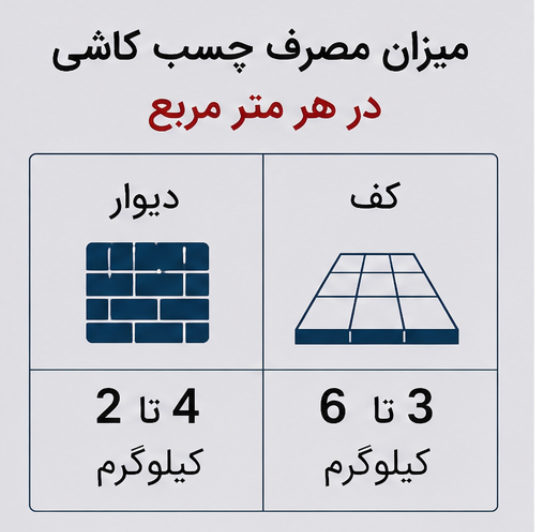
Tile adhesive usage for floors vs. walls — accordingly, what you need to know
One point that many people overlook when estimating tile adhesive quantity is the difference in adhesive consumption between floors and walls. At first glance, it may seem that if the area of two spaces is the same, the adhesive usage should also be the same. However, in practice, the installation conditions, tile type, and the amount of pressure applied to the surface create differences in adhesive consumption.
For wall tiling, the main goal is usually to create proper adhesion between the tile and the substrate. Since the wall does not bear pressure from foot traffic or heavy objects, a thinner layer of adhesive often achieves the desired result. Therefore, adhesive consumption on walls is usually lower than on floors, typically ranging between 2 to 4 kg per square meter.
However, this assumes that the wall surface is already smooth and properly prepared. If the wall has depressions, bumps, or unevenness, the installer will need to use more adhesive to level the surface, which increases consumption beyond typical figures.
For floor tiling, the conditions are more critical. Floor tiles must withstand the weight of people, furniture, appliances, and various pressures over the years. If the installer does not properly cover the area beneath the tile with adhesive, the likelihood of voids increases. These voids can later cause cracking, breakage, or loosening of the tiles.
Therefore,
in floor installations, installers make greater effort to achieve maximum contact between the tile and the substrate. This means using a larger volume of adhesive, and as a result, consumption increases. In most flooring projects, adhesive usage ranges between 3 to 6 kg per square meter, and in some special conditions it can be even higher.
Another important factor affecting the difference in adhesive consumption between floors and walls is tile size. Today, large-format and porcelain tiles have become very common. These tiles weigh more and require more complete adhesive coverage for proper installation. As a result, projects using large tiles typically consume more adhesive than those using smaller tiles.
In many cases, especially for large porcelain tiles, the installer applies adhesive to both the substrate and the back of the tile (a technique called back-buttering). This method increases strength and reduces the likelihood of future tile detachment — but naturally, it also increases adhesive consumption.
Additionally, the type of space being tiled matters. For example, in wet areas such as bathrooms, toilets, balconies, or exterior spaces with higher moisture and temperature fluctuations, more thorough coverage and precise application become even more important. Consequently, adhesive consumption may be slightly higher than in a typical interior space.
In conclusion, although a fixed number cannot apply to all projects, adhesive consumption is generally higher on floors than on walls. Therefore, when calculating the required adhesive quantity, it is better to calculate floor and wall areas separately and consider the specific conditions of each. This will give you a more accurate material estimate and help you avoid running out of adhesive or purchasing excess during the project.
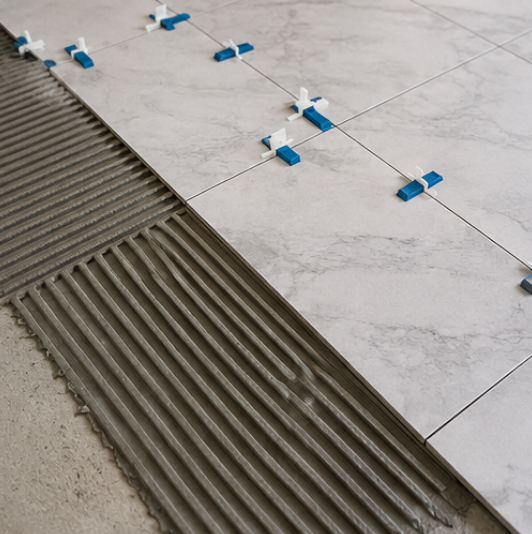
Coverage per bag of tile adhesive — accordingly, how many square meters per bag?
This is one of the most frequently asked questions by people planning to purchase tile adhesive. Many people know the square footage of their space, but they don’t know how many bags of adhesive to buy. As a result, they may run out of materials in the middle of the project or, on the other hand, end up buying too much adhesive, which increases the overall cost.
In most cases, powder tile adhesive is available in 20 kg or 25 kg bags. How many square meters each bag covers depends on the adhesive consumption rate per square meter. As mentioned earlier, adhesive consumption typically ranges between 3 to 6 kg/m².
For example, if your project’s average consumption is about 4 kg/m², a 20 kg bag will cover approximately 5 square meters, and a 25 kg bag will cover about 6 square meters. However, if consumption rises to 5 kg/m² due to uneven substrate or large-format tiles, these figures will decrease accordingly.
Therefore, when calculating the required adhesive quantity, it is better not to focus only on the square footage. The substrate condition, tile type, and installation method should also be included in your calculations. Furthermore, it is recommended to purchase about 5 to 10% more than the calculated amount, so that the project does not stall in case of increased consumption or installation errors.
In practice, the best way to determine the number of bags needed is to first multiply the total project area by the average adhesive consumption rate, and then divide the resulting number by the weight of each bag. This method usually provides the most accurate estimate and prevents buying too little or too much.
Summary
Tile adhesive consumption per square meter depends on various factors, and therefore, a fixed number cannot apply to all projects. However, in most projects, adhesive consumption typically ranges between 3 to 6 kg per square meter. Factors such as adhesive type, tile size, substrate quality, layer thickness, and installer skill can all increase or decrease this amount.
We also observed that adhesive consumption on floors is generally higher than on walls, because floors must bear greater pressure and weight and therefore require more complete adhesive coverage. On the other hand, using large-format and porcelain tiles can also increase consumption compared to standard tiles.
If you want an accurate estimate of the required adhesive quantity, carefully assess both the project area and the installation conditions before purchasing, rather than relying solely on general averages. This approach not only prevents material waste and unnecessary costs but also helps ensure a higher-quality and more professional installation. Finally, the more precise your initial calculations, the more confidently and smoothly the project will proceed.