
Before the invention of tile adhesive, a combination of sand and cement was used to bond tiles and ceramics to walls and floors. However, with the introduction of tile adhesives, the process of installing tiles is faster, easier, and more accurate. Tile adhesives have become a popular and convenient option for installing tiles due to their many advantages over cement. In this article, we will review the types of tile adhesives, their compositions, and the advantages and disadvantages of these products.
What is tile adhesive?
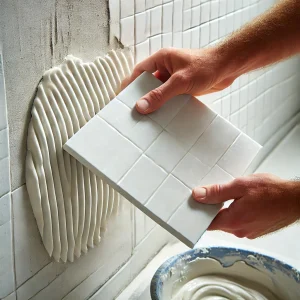
Tile adhesive is a flexible material that does not crack or shrink with changes in temperature and humidity. This product is made up of chemical and mineral materials such as Portland cement, fine sand, and adhesive additives. Tile adhesive is actually a type of inorganic polymer cement that has high adhesive strength and low weight. These features make tile adhesives perform the installation process of ceramic and tile faster and with less energy. Ultimately, this adhesive effectively bonds tiles to different surfaces and ensures their durability and strength.
Types of tile adhesive
Tile adhesives are generally classified into three main categories: thinset, mastic, and epoxy.
Thinset tile adhesive
Thinset is one of the most common types of adhesives for tiles. It is usually made from cement and, after mixing with water, gains a good consistency and adhesion. Thinset is resistant to moisture, heat, and mold, and can relatively level uneven surfaces. Therefore, it is a good choice for installing tiles in wet areas such as bathrooms. Of course, thinset may crack over time, but latex additives can be used to improve its flexibility.
Mastic tile adhesive
Mastic adhesive is a water-based acrylic adhesive that is readily available. It performs better in dry areas and is not resistant to moisture and heat. The advantages of mastic adhesive include its ease of use and cleaning. It can also be stored for a long time. However, mastic adhesive is not suitable for use with glass tiles.
Epoxy tile adhesive
Epoxy is the strongest type of adhesive made from resin. It bonds quickly to surfaces, is waterproof, and resists chemicals and grease, making it ideal for industrial use. However, it is more expensive than other types and requires professional handling.
In the Iranian market, paste and powder tile adhesives are very popular and available.
Paste tile adhesive
Paste adhesive has a high resistance to water penetration, making it a good choice for wet environments such as bathrooms, swimming pools, and areas with high rainfall. It works especially well for installing tiles on plaster surfaces and shows good resistance to pressure and tension. Additionally, it is resistant to petroleum derivatives, acids, and water.
Powdered tile adhesive
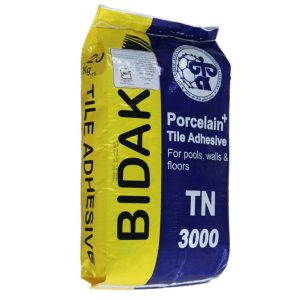
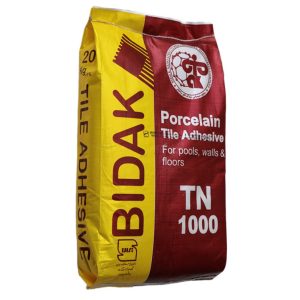
Powdered adhesive has less adhesion than paste types and isn’t recommended for plaster walls. Made from dry cement-based mortar, it becomes moisture-resistant when mixed with water. It’s mostly used on smooth surfaces like brick, old tiles, stone, and cement. Bidek Nanostructure Chemical Industries offers this product at a reasonable price. Powdered adhesive comes in two types: single-component and two-component.
Single-component powder tile adhesive
Single-component powder adhesive has lower adhesion and quality than the two-component type, making it more suitable for installing light tiles on the floor. Due to its low adhesion, it is better not to use it for walls or in humid environments. To improve its performance in such conditions, using an insulating adhesive on the tile surface is recommended.
Two-component powder tile adhesive
Two-component powder adhesive is stronger and higher quality than the single-component type. It can install various tiles and ceramics of different weights on different surfaces. Due to its quality, it’s more expensive and typically used by professionals.
Benefits of tile adhesive
Tile adhesives have many advantages that make them a superior choice over cement:
- High strength: Adhesive has much higher adhesion than cement and prevents tiles from loosening.
- Ease of use: Using tile adhesive is faster and cleaner than cement and requires less time to install.
- Moisture resistance: Tile adhesives are well resistant to moisture and water.
- Usability on all surfaces: Tile adhesive works well on all surfaces, including plaster, cement, stone, and old tiles.
- Structural weight reduction: Using tile adhesive helps reduce the overall weight of the building.
Disadvantages of tile adhesive
Tile adhesive also has some disadvantages:
- Higher cost: The price of tile adhesive is higher than cement.
- Limited strength in some conditions: In some cases, tile adhesives may crack after some time.
- Limitations in some environments: Some types of tile adhesive are not suitable for use in swimming pools or environments with high humidity.
Conclusion
In conclusion, modern adhesives have greatly improved tile installation, offering faster, more precise, and efficient results compared to traditional sand and cement methods. These adhesives provide strong bonds, resist moisture, and withstand temperature changes, making them the preferred choice for many construction projects.
There are various types to suit different needs. Thinset is commonly used for wet areas like bathrooms, but it may crack over time without additives. Mastic is easy to apply and clean, ideal for dry areas, while epoxy offers the strongest bond, making it perfect for industrial use, though it requires professional handling.
In the Iranian market, powdered and paste adhesives are popular. Powdered adhesives come in single- and two-component versions. Single-component adhesives are suitable for lighter tiles but offer less adhesion, while two-component adhesives are stronger and more suitable for heavier tiles, though they are more expensive.
Overall, modern adhesives offer better adhesion, moisture resistance, and faster installation than traditional methods. While they can be pricier and may not always be ideal for every condition, they provide a durable, long-lasting bond and are the superior choice for most tile installation projects.