
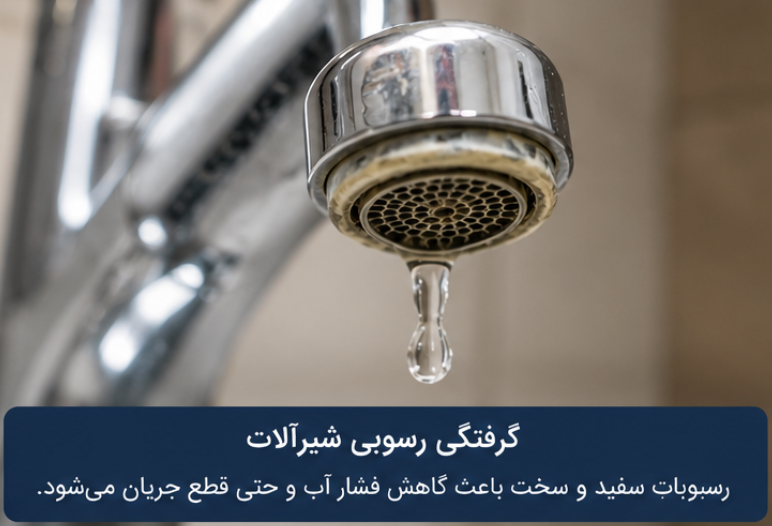
Causes of low water pressure and no water flow from the faucet — therefore, a guide to unclogging faucets
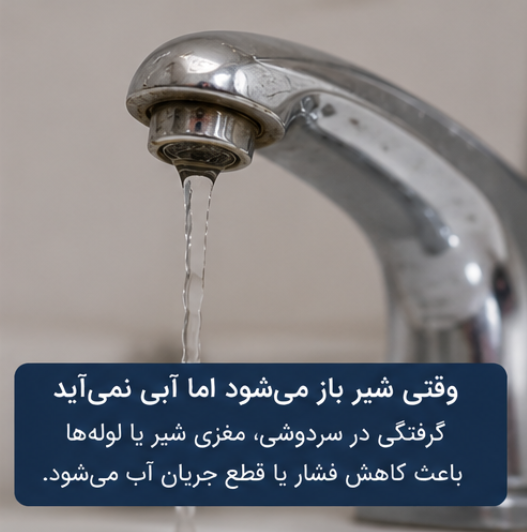
You have probably experienced this before. For example, you wake up in the morning, put your hand under the faucet, turn it on — but no water comes out. Not that someone has cut off the water supply. No. The neighbors have water. The problem is only with your own faucets. Or perhaps in the bathroom, which you haven’t used for a few days, the faucet has become clogged and won’t let water through.
Many people think this problem only happens in old houses. However, they are mistaken. In fact, even in newly built homes, the same thing happens after a while. Therefore, in this article, we want to understand why faucets and pipes become clogged, what materials cause this blockage, and — more importantly — if your faucet is clogged, how to fix it without causing any damage.
Limescale: the most important cause of faucet clogging and low water pressure
What factors other than limescale cause pipe and faucet blockages? Accordingly, a complete review of the reasons
How can we tell what type of clog your faucet has? (Simple and quick diagnostic methods)
How to unclog a faucet without damaging or breaking it
Limescale: the most important cause of faucet clogging and low water pressure. Accordingly, here's what you need to know
Let’s get to the main issue. What causes your home’s faucets and pipes to become clogged and stop letting water through after a while is an unwelcome but very familiar guest: limescale.
Limescale is the hard, white layer that you see after some time around the faucet aerator, around the showerhead, or at the bottom of a kettle. Many people think this white layer only makes the faucets look ugly. However, they are mistaken. In fact, this very limescale can gradually block the water path and render your faucet useless.
Where does this limescale come from?
The water that comes through the city pipes to your home is not pure and free of other substances. This water contains various dissolved minerals. The most important of these minerals are calcium and magnesium. These two substances are dissolved in the water and are invisible. However, when the water heats up or sits on a surface and evaporates, these minerals separate from the water and settle as a hard, white layer on that surface.
Water that has high levels of calcium and magnesium is called hard water. The harder the water, the more limescale it produces. Accordingly, many regions in Iran have hard water.
How does limescale clog the faucet?
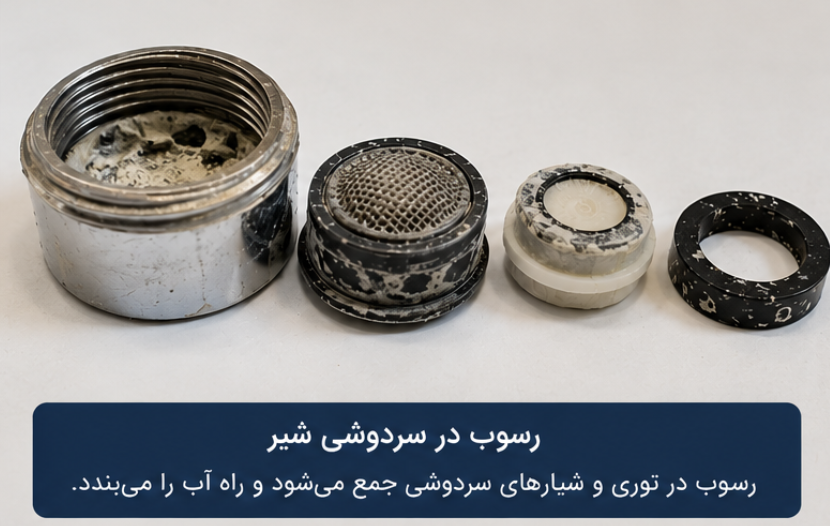
Faucets have several sensitive parts. The most important of these is the aerator (or perlator). This is the part screwed onto the end of each faucet that disperses the water as a bubbly, spread-out stream. Inside this part, there is a fine mesh screen and several narrow channels. Water passes through this mesh and channels in order to be dispersed.
This is precisely where limescale lies in wait. Fine particles of limescale suspended in the water stick to this fine mesh. Gradually, layer upon layer of limescale accumulates until the mesh becomes completely blocked. As a result, water can no longer pass through. The outcome is a faucet that you turn on, but either no water comes out or only a weak drip.
Limescale does not only clog the aerator
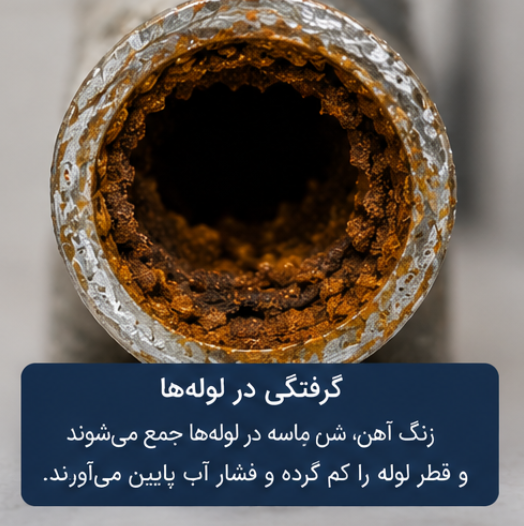
The aerator mesh is not the only place where limescale collects. Inside hot water pipes, the situation is even more critical. Specifically, when hot water flows through the pipes, more limescale settles out. Over time, the pipes become narrower and narrower from the inside. As the pipe diameter decreases, water pressure drops, and less water reaches the faucets.
These same limescale deposits eventually cause thermostatic valves, lever valves, and even ball valves to fail. Accordingly, limescale settles on the moving parts inside the valve, prevents them from moving properly, and the faucet no longer opens and closes correctly.
Now, let’s move on to the next section: what other factors besides limescale can clog pipes and faucets.
What factors besides limescale cause pipe and faucet clogging? Accordingly, here is a complete breakdown of the causes
Limescale is the number one killer of faucets, but it is not the only killer. In fact, several other factors can also disable the pipes and faucets in your home. Some of them are even more dangerous than limescale.
The second killer: rust particles from old pipes
If your home is old or the pipes are made of black or galvanized iron, you have another significant problem. Specifically, these metal pipes rust from the inside over the years. Rust particles gradually detach from the pipe walls and travel with the water. When these fine black and brown particles reach the faucets, they collect inside the aerator and fine crevices, then harden like cement. Consequently, clogging caused by rust is usually harder and more resistant than limescale.
The third killer: sand, grit, and silt
The water that enters your home from the city pipes is not always perfectly clean. For example, sometimes after water network repairs or following floods and heavy rains, sand, grit, and silt enter the pipes. When these particles accumulate, they form a compact layer that reduces water flow. The faucet aerator is typically the first place where these particles get trapped.
The fourth killer: fragments of washers and plastic parts
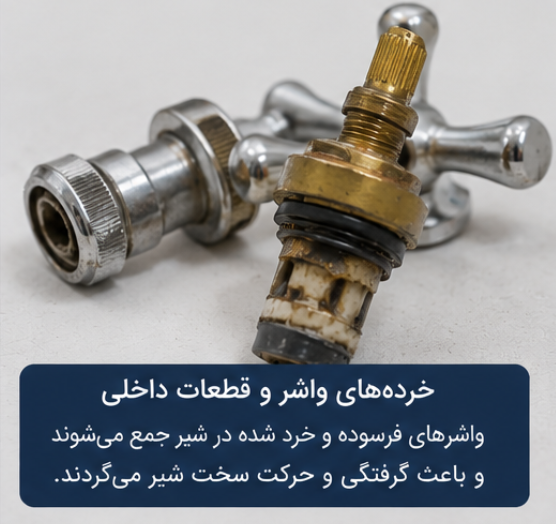
Inside faucets, there are rubber and plastic washers. After several years of use, these washers gradually wear out and break into pieces. These fragments move through the water and become lodged in the aerator or the valve cartridge. Importantly, these plastic particles neither dissolve in acid nor are they easily flushed out by water pressure. On the other hand, these same fragments also make it easier for limescale and rust to settle.
The fifth killer: grease and oil
This may sound surprising, but grease and oil can also cause clogging. For instance, in the kitchen, tiny grease particles enter the water when washing dishes. This grease sticks to the inner walls of the pipes. Over time, limescale deposits on this greasy layer, forming a hard, sticky coating that is difficult to remove.
The sixth killer: blockage in the main pipe behind the wall
Sometimes the problem is not with the faucet itself. Instead, the main pipe behind the wall becomes clogged. In this case, water pressure drops throughout the entire house. Accordingly, if only one faucet has a problem while the others work fine, the issue is localized. However, when the main pipe is clogged, all faucets have low pressure or no water. This type of blockage usually occurs at the main pipe bends and fittings.
How to identify the type of faucet clog? Accordingly, simple and fast ways to diagnose the problem
Now that we understand the several types of factors that can cause faucet clogging, we need to diagnose which problem exists in our home. Distinguishing between different types of clogs is very important, because each one has its own specific solution. Therefore, if you misdiagnose, you might end up damaging the faucet.
Signs of limescale clogging
If the problem is limescale, typically the hot water faucets become clogged sooner than the cold water faucets, since hot water produces more limescale. When you turn on the faucet, either no water comes out at all, or it only drips out very weakly. Additionally, if you remove the aerator, you will see a hard white layer around the mesh screen. This layer can be easily removed with vinegar or anti-limescale products.
Signs of rust clogging
If your home has old metal pipes, the likelihood of rust clogging is high. In this case, the water coming out of the faucet may have a brownish or yellowish color. Furthermore, when you remove the aerator, you will see fine black and brown particles inside. These particles do not dissolve in vinegar and typically need to be cleaned with water pressure or a small brush.
Signs of sand and grit clogging
If there have recently been pipe repairs in your area or heavy rainfall has occurred, the likelihood of sand and grit entering the pipes is high. In this situation, the water may appear cloudy or muddy. When you remove the aerator, you will see particles resembling sand or soft dirt. Generally, these particles are removed with simple washing; however, they may re-enter the pipes several times before the system is completely clean.
Signs of clogging from washer fragments
If your faucet has been working for several years and has gradually lost pressure without any visible limescale or rust, the problem is likely worn internal washers. In this case, the faucet feels stiff when opening and closing, and it may produce unusual noises. The washer fragments are usually very small and difficult to see, as they are flushed away with the water.
A quick way to diagnose
Perform a simple test: remove the aerator from the faucet and take out its mesh screen. Then, turn on the faucet without the aerator. If the water pressure returns to normal, the problem is only in the aerator, and it can be solved with a simple cleaning. On the other hand, if the pressure is still low or no water comes out even without the aerator, then the problem is inside the faucet itself or in the main pipe, and it needs to be examined more carefully.
How to unclog a faucet without causing damage? Accordingly, follow these steps
Now we have reached the most important part of the article. Now that we understand what type of clog our faucet has, it is time for action. Therefore, there are several methods for unclogging a faucet — from the simplest household methods to slightly more advanced ones. Accordingly, it is best to start with the first method and, if it does not work, move on to the next.
Method one: cleaning the aerator (perlator)
The aerator is the part attached to the end of each faucet that disperses the water. This method works for about 90% of simple clogs. First, turn off the water supply to the faucet. Then, using your hand or a soft pair of pliers, rotate the aerator counterclockwise to unscrew it. Be careful not to scratch the faucet body.
After removing it, you will see a fine mesh screen and several grooved plates inside the aerator. Take these parts out. Using an old toothbrush, clean off all the limescale, rust, and silt. If the white limescale is hard and stubborn, soak the aerator overnight in a bowl of white vinegar. In the morning, clean it again with the toothbrush. Vinegar dissolves limescale without damaging the parts. Never use bleach or hydrochloric acid (muriatic acid), as these will damage the plastic and rubber components.
After cleaning, reassemble all the parts and screw the aerator back onto the faucet. Turn the water back on. If the water pressure returns, the problem has been solved.
Method two: cleaning the faucet cartridge
If, even without the aerator, the water does not flow properly, the clog is inside the faucet itself. In this case, you need to address the faucet cartridge. The cartridge is the internal part that controls water flow when you turn the handle.
First, shut off the main water supply. Then, remove the handle. Depending on the faucet model, there is either a screw behind the handle or a plastic cap on top of it. Remove the screw and detach the handle. Now the cartridge is exposed. Using the appropriate wrench, unscrew the cartridge counterclockwise.
Take the cartridge out. Inside, there are washers and small channels. Using a toothbrush and vinegar, clean all the components. If the washers are damaged or have disintegrated, replace them with new ones. If there is heavy limescale buildup on the cartridge, soak it in vinegar for several hours. After cleaning, reassemble the cartridge, reinstall the handle, turn the main water supply back on, and check the result.
Method three: unclogging the pipe behind the wall
If cleaning the aerator and the cartridge does not solve the problem, the clog is inside the pipes behind the wall. Before calling a professional pipe unclogging service, try a simple method. Turn the faucet on, then use a wooden hammer or the handle of a screwdriver to gently tap the pipe behind the faucet several times. Sometimes these vibrations dislodge the accumulated limescale or trapped particles, clearing the path.
Method four: replacing the faucet
If none of these methods work, then so much limescale, rust, and debris have accumulated inside the faucet that it is no longer repairable. In this situation, replacing the faucet is usually both cheaper and faster than repairing it. Therefore, purchase a new faucet and replace the old one.
Conclusion
Faucets and household pipes typically become clogged due to hard water limescale, rust, sand, grit, or fragments of worn washers. Fortunately, most of these clogs can be resolved by cleaning the aerator using vinegar and a toothbrush. If this method does not work, then you should proceed to cleaning the faucet cartridge. However, never use a needle or blade to clean the mesh screen, as this will damage it.
Accordingly, if none of the methods produce results, replacing the faucet is the best course of action. Finally, to prevent clogging in the first place, it is advisable to remove and clean the aerator every few months. Furthermore, if your home has hard water, using a water softener device is highly recommended.